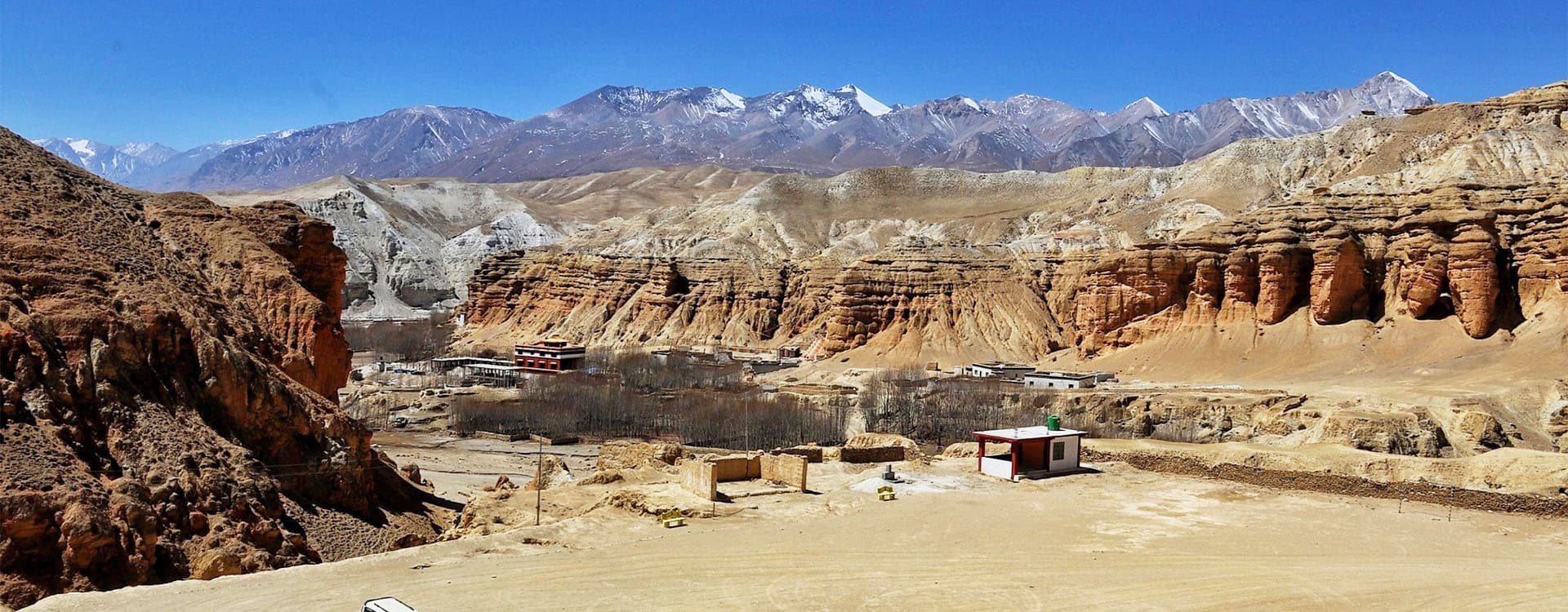
Tucked away behind the giant Annapurna and Dhaulagiri ranges, Upper Mustang is one of Nepal's most remote and restricted regions, often called the "Last Forbidden Kingdom." The arid, high-desert landscape was once an independent Tibetan kingdom, and the terrain here differs from the rest of the Himalayas: wind-eroded cliffs, riverbeds that are dry except during monsoon, and ochre canyons that seem to go on forever. But apart from its breathtaking scenery and centuries-old Tibetan culture, Upper Mustang holds one of the most intriguing archaeological secrets of the Himalayas, the Sky Caves.
Pockmarking the steep canyon walls and vertical cliffs, thousands of man-made caves, some over 2,000 years old, are carved high above the ground, inaccessible without ropes or ladders. The caves were once homes, burial chambers, meditation retreats, and monasteries. Archaeologists have found within them human mummies, ancient manuscripts, Buddhist frescoes, and other priceless artifacts, offering a glimpse of a vanished civilization that centuries ago thrived along these high Himalayan trade routes.
Most of these caves remain unexplored to this day. A few have been opened to trekkers and researchers, particularly in villages like Chhoser, Yara, and Lo Manthang, where history seems to hang in the air, and from the cliffs.
If you are curious about the origin, significance, and how to visit these high-up marvels, this blog will guide you through everything you would wish to know about the mysterious Sky Caves of Upper Mustang, one of Nepal's most fascinating and least visited wonders.
Where Are the Sky Caves Located?
The Sky Caves are scattered across the towering, wind-blasted cliffs and river canyons of Upper Mustang in northwestern Nepal. Situated within the trans-Himalayan rain shadow, the area is between the rugged Annapurna and Dhaulagiri mountains to the south and dry Tibetan Plateau to the north. As the heart of the ancient Kingdom of Lo, Upper Mustang is a barren and isolated land of eroded sandstone cliffs, valleys in ochre hues, and whispering winds, and the Sky Caves are found hidden mysteriously within these cliffs.
Most of the significant cave complexes are located around Lo Manthang, walled capital of Upper Mustang, and radiate outwards to far-flung villages like Chhoser, Yara, Ghara, and Tangge. They are often located well above ground level, in some cases hundreds of feet up, and excavated directly from sheer rock faces, often requiring the use of modern climbing equipment in order to access them.
Major Sky Cave Locations:
1. Chhoser Village (north of Lo Manthang):
This area has the most accessible and popular Sky Caves. The caves around Chhoser were used for meditation, shelter, and burial, and several of them have old Buddhist paintings and ancient artifacts still inside them. These caves are usually multi-level and consist of maze rooms and small shrines, and are a must for trekkers exploring Lo Manthang.
2. Yara and Ghara Villages (east of Lo Manthang):
These villages are famous for having the Luri Gompa, a stunning cave monastery carved out of a sandstone cliff. Inside Luri Gompa, visitors will find beautiful murals, ancient statues, and even whole chortens, adding to an otherworldly and consecrated atmosphere. The region also holds other sky caves believed to be ritual or burial chambers.
3. Cliffs Above the Kali Gandaki Gorge
Certain of these caves are located near the Kali Gandaki Gorge, the deepest gorge in the world. These remote caves have interested archaeologists as their discovery shed light on ancient human remains, scrolls, and relics, which informed the people about the early life, religious life, and migrations within the Himalayas.
Together, they form one of the most interesting archaeological landscapes of the Himalayas, with each cave holding strata of unended history. Their locations, carved high up in sheer isolation, continue to evoke interest, awe, and queries that researchers and spirituality seekers alike are still trying to unravel.
The History and Purpose of the Sky Caves
The Upper Mustang's Sky Caves are not only visually stunning, they are historically enigmatic in purpose and creation. These caves of humans, carved into the fragile sandstone walls of Upper Mustang, date back more than 2,000 years, yet even today, their exact use and their creators remain somewhat mysterious.
Archaeological digs over the past two decades have finally pulled back the veil of secrecy from these vertical dwellings, informing us how they were modified over the centuries and what they meant to the people of Mustang's high-desert.
1. A Multi-Functional Legacy
The caves served different purposes at different times in Mustang's long and complex history:
Burial Chambers (circa 1000 BCE–1000 CE):
Some of the first caves appear to have been burial sites or crypts, in which the remains of humans were found buried deep inside. University of Cologne and other international teams of archaeologists discovered mummified corpses, bones, and artifacts that suggest early sky dwellers practiced sky burials or buried their dead in cliffs for religious reasons.
2. Habitations and Refuge (medieval period)
During the medieval period (1100s–1600s), some of the caves were used as houses, storehouses, or as safe havens during war. The caves were used as a safe haven from invasions and tribal wars so that families could escape high above the valley floor, as per local legends and oral stories.
3. Monastic and Ritual Use (past and present):
Several caves, for instance, those near Luri Gompa and Chhoser, were clearly meant for religious meditation and monastic life. They possess, within their walls, old Tibetan Buddhist frescoes, chortens (stupas), inscriptions, and sculptures dating as far back as the 13th century. They remain spiritually significant to local people and sometimes are used for meditation by monks and travelers even today.
Why Carve into the Cliffs?
Mustang's remote location and rocky landscape made cliff face dwelling practical and strategic:
Safety from enemies, floods, and ferocious animals.
-
Maintenance of bodies and sacred items in the dry, cool weather.
-
Spiritual proximity to the mountains and sky, believed to bring one closer to enlightenment.
How ancient man climbed hundreds of feet to cut and live in these caves continues to be a matter of fascination. Caves that are inaccessible without climbing equipment today enhance the feat even more.
Why Are They Called "Sky Caves"?
The name "Sky Caves" is not an exaggeration. The caves are actually excavated out of cliffs towering over Mustang, some perched vulnerable 50 to 150 feet over valley floor level. From the floor below, they appear to float in mid-air, pinned improbably to dizzying rock faces. Their secluded and inaccessible position, amidst the backdrop of stark scenery of barren mountains and Kali Gandaki Gorge, gives them an alien-like quality, as if they were homes or tombs suspended between heaven and earth. For those reasons, a divine perspective, visitors and inhabitants alike referred to them as "Sky Caves."
Entering most of the caves today still requires ropes, wooden ladders, or mountaineering skills, which is all the more astonishing that ancient people carved them with no toolery in contemporary times. Their location was not for show, since it was performed in a function that was useful and spiritual in purpose, including shelter from dangers below and proximity to the heavens above.
Who Constructed the Sky Caves, and Why?
Their own builders are also lost in time. Archaeologists date them more than 2,000 years ago, and quite possibly earlier. Successive periods of Mustang's history placed new overlays of function and meaning. Although absolute records are sparse, what human remains and artifacts were discovered inside their walls provide significant insight.
The Sky Caves served several functions across centuries:
1. Burial Chambers
The first caves were likely used for burials. Human remains, mummified bodies, and objects such as copper tools, beads, and clay vessels were discovered through archaeological excavations. Some of these burials, carbon dated, date back as far as 3,000 years. High altitude and dryness provided the ideal natural preservation conditions for these caves.
2. Meditation Retreats
Tibetan Buddhism spread throughout the region, and monks and spiritual practitioners used these caves as meditation and solitude retreats. Some caves still exist today with ancient Buddhist murals, prayers written, and small chortens, showing their spiritual function.
3. Storage and Living Areas
Entire families most likely sought refuge in the caves in war or disaster. Home occupation evidence found, such as shooting on ceiling surfaces caused by cooking fires and storage shelves cut out of walls, suggest prolonged use.
4. Monasteries and Hermitages
Where, for example, in the likes of Luri Gompa, caves were modified to form isolated monastic complexes. Others house sacred relics and paintings that reflect Bon (pre-Buddhist religion) and early Tibetan Buddhist influences, giving an insight into Mustang's spiritually complexly layered heritage.
Briefly, the Sky Caves were not built for any particular reason but evolved over time to meet the religious beliefs and the needs of Mustang's ancient society. Their age-old mystery still fascinates scholars, adventurers, and seekers of the divine alike.
Does anyone still use the caves today?
Although most of the Sky Caves of Upper Mustang are today empty remnants of ancient cultures, several continue to be used today, particularly for spiritual and practical purposes. Buddhist hermits and wandering monks will from time to time retreat into these caves to meditate, isolate themselves, and pray, believing that the remote setting enhances concentration. Some religious ceremonies and rituals are still practiced in certain caves, mainly those within Chhoser and Luri Gompa.
Aside from religious purposes, there are certain caves that are occupied seasonally as storage rooms or shelters by local herders and villagers. During cold winter months or during seasonal migration, the caves serve as windbreaks against cold winds and temporary shelters for both animals and human beings. However, because some of the caves are found at high grounds on cliffs, their widespread utilization has significantly decreased, and few are well-maintained.
A few of the more accessible cave monasteries, including Luri Gompa and Nyphu Gompa, are still of religious significance and pilgrimage destinations as well as trekking enthusiasts looking to experience the rich culture of these surroundings. Others are inaccessible or in a state of disrepair, but the Sky Caves endure to connect Mustang's ancient heritage to its contemporary traditions.
Permits and Access Information
A trip to Upper Mustang's Sky Caves is an organized activity, as the location falls under Nepal's Restricted Area category. The government aims to preserve its unique cultural, historical, and geopolitical value, especially with its proximity to the Tibetan border and the fragile condition of most cave locations.
To legally and morally enter the Sky Caves, you will need the following permits:
1. Restricted Area Permit (RAP) for Upper Mustang
-
Cost: USD $500 per individual for the initial 10 days
-
Extension: USD $50 per person per day for each day more than 10
-
Provides entry to villages such as Lo Manthang, Chhoser, and nearby cave sites.
2. Annapurna Conservation Area Permit (ACAP)
-
Cost: NPR 3,000 per person (approximately USD $22–25)
-
Required as the Upper Mustang trek traverses conserved parts of the Annapurna region.
3. Group Requirement:
-
Atleast two trekkers are an absolute requirement.
-
You need to be with a registered trekking guide and get all your permits through a registered trekking agency.
All arrangements for necessary permits and logistics are taken care of for you under the guided Upper Mustang trek packages in Utmost Destination. This ensures an enjoyable, compliant, and well-supported journey so that you can focus on exploring the mystical ancient caves, holy sites, and landscapes that define this enchanted land.
What to Do on a Sky Caves Tour in Mustang?
Upper Mustang Sky Caves tour is a rare journey of integrating tough Himalayan landscapes, ancient human history, and deep spiritual reverence. Unlike typical tourist spots, these caves invite hiking, immersion in natural Tibetan Buddhist life, and a wonder only centuries-old mysteries can offer.
1. Moderate Hiking and Climbing
To reach the Sky Caves, especially those around Chhoser and Yara, you’ll embark on short but moderately steep hikes along dusty trails and narrow ridgelines. Some caves are located 50 to 150 feet above the ground and are accessible only through wooden ladders, rope climbs, or carved rock steps. While technical climbing isn’t necessary, you’ll need a fair level of fitness, good hiking shoes, and a spirit of adventure to enjoy the journey safely and comfortably.
2. Unforgettable Himalayan Views
Upper Mustang is a high-altitude desert area, nestled between the Tibetan Plateau and the Himalayas. The Sky Caves are perched on top of monumental cliff faces, wind-weathered canyons, and reddish-colored valleys. From an entrance to one of the caves, you can gaze out across miles of untainted wilderness, with snow-capped peaks like Nilgiri and Dhaulagiri rising into the distance. These photographic vistas do more than simply offer scenery, they give a sense of timelessness and remoteness that few others can rival.
3. Immersion in Deeper Culture
Rooted deeply in the spirituality and cultural practices of Upper Mustang, the Sky Caves are. They are near sacred sites such as Luri Gompa, a 13th-century cave monastery whose walls are painted with ancient murals, or Nyphu and Ghar Gompa, which are both sites of Buddhist prayer. While there, you can have the chance to encounter the local monks, observe rituals, or sit quietly while the chanting resounds through the caves. It's a true cultural experience in one of Nepal's most remote and spiritually productive areas.
4. Mystery and Wonder
What actually makes the Sky Caves special is their archaeological and historical enigma. These contain 3,000-year-old human skeletons, mysterious inscriptions, or wall paintings dating back to early Bon or pre-Buddhism times. They are studied by scholars and archaeologists to this day, but many questions remain unasked. It is a sense of mystery and holiness that one experiences, and taking each step into a cave is like entering another era. For most tourists, it's not a trip, it's a discovery.
FAQs On the Sky Caves of Mustang
1. Are the caves safe to visit?
Yes, the open caves, particularly the ones near Chhoser and Lo Manthang, are safe and guided by local guides. Some involve simple climbing or narrow passages, but with a suitable guide and good shoes, they're accessible to most trekkers in reasonable health. Your guide will ensure safety precautions are followed when you visit.
2. Can I visit the Sky Caves alone?
No. The Upper Mustang region is a Restricted Area according to the Government of Nepal. Tourists must be accompanied by a licensed guide and must pass through a registered trekking agency. Further, a group must consist of at least two persons (excluding the guide), whereby sustainable tourism and protection of this sensitive heritage is ensured.
3. How old are the Sky Caves?
The majority of the caves are over 2,000 years old, even though some human burials and remains discovered within suggest a closer age of about 3,000 years or more. They have been for centuries places used for an array of activities from funeral rites and meditation to domestic residences and religious shrines and are thus a living archive of Upper Mustang's religious and historical past.
4. Is photography and film permitted?
Yes, photography is allowed in most accessible Sky Caves. However, permission has to be sought, particularly in those that are still connected with active monasteries or spiritual activities. Certain cave paintings or relics are fragile and might be off-limits for flash photography or the use of drones to ensure that these old sites are not damaged.
Conclusion
The Upper Mustang Sky Caves are not just an archaeological wonder, they're an access point to ancient civilizations, lost spiritual heritage, and peaceful determination of Himalayan culture. Perched high above the Kali Gandaki Gorge and hidden behind Mustang's red-rock cliffs, the caves continue to awe, amaze, and inspire reverence in all those who see them.
With their blend of historical mystery, dramatic scenery, and vibrant Tibetan Buddhist culture, the Sky Caves provide an experience unlike any other in Nepal. As an adventurer, historian, photographer, or spiritual traveler, this destination offers not only a trek, but a transformation.
Exploring such old cliff dwellings requires more than physical effort, it requires respect, commitment, and proper care. Utmost Destination facilitates your visit to be safe, well-planned, and meaningful and interesting. Enjoy this once-in-a-lifetime experience with us and uncover the unheard stories inscribed in Upper Mustang cliffs.