Introduction
Upper Mustang sits beyond the Annapurna and Dhaulagiri ranges, a high-altitude desert kingdom tucked into Nepal's far west. For centuries this was the independent Kingdom of Lo, sealed off from outsiders and ruled by its own laws. That isolation preserved something rare: ancient monasteries, cave dwellings, and Tibetan Buddhist traditions that survive almost unchanged today.
Nepal opened the region to travelers in 1992, and since then, Upper Mustang has earned its nickname, the Last Forbidden Kingdom. Few events capture that spirit better than the Tiji Festival, a three-day masked dance ceremony held in the walled city of Lo Manthang. It is one of the most vibrant and least commercialized Buddhist festivals still practiced in the Himalaya.
This guide covers everything you need to plan your 2026 trip: festival dates, permits, trekking and jeep routes, where to stay, and what to expect once you're standing in that dusty courtyard watching monks in painted masks reenact a 600-year-old legend.
What is the Mustang Tiji Festival?
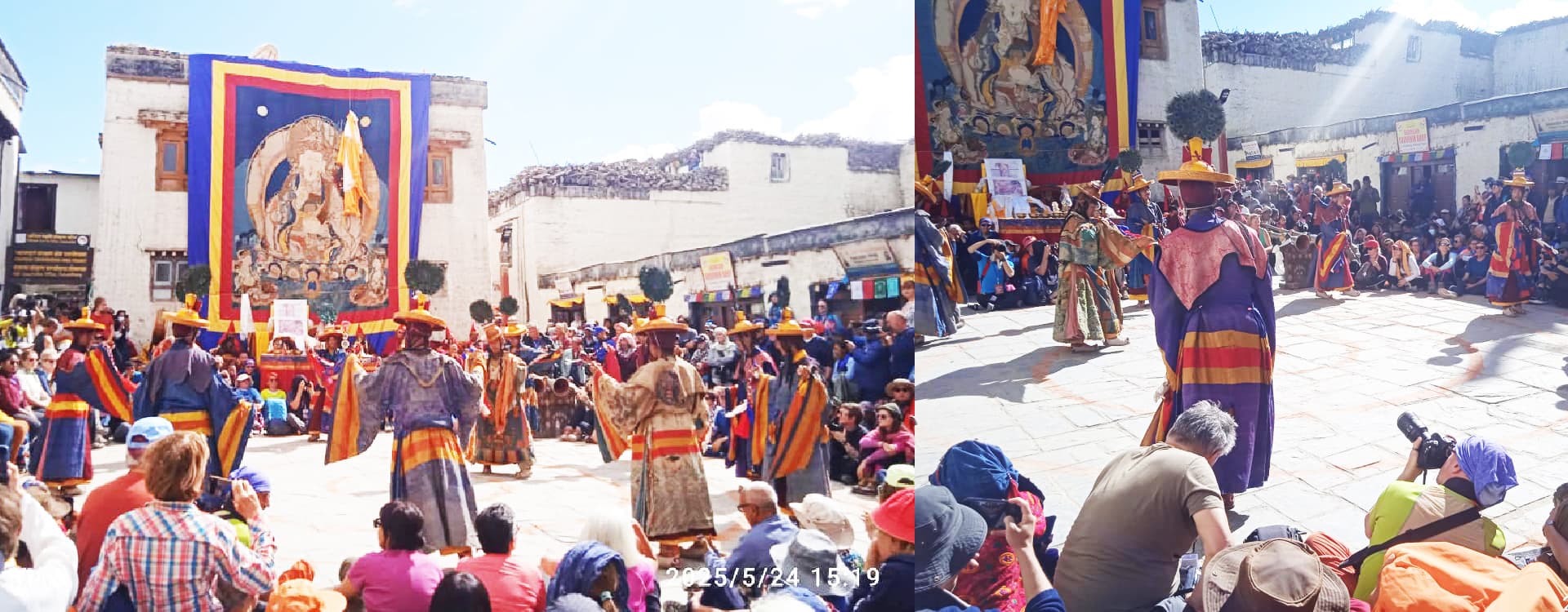
The Tiji Festival is a three-day sacred masked dance ceremony performed by monks of the Choedhe Monastery in Lo Manthang, the walled former capital of Upper Mustang. Locally, the event is also called Tenchi, short for Tempa Chhirim, which translates to "prayer for world peace." That name captures the festival's core purpose: it is not staged for spectacle; it is a ritual meant to protect the region for the year ahead.
The festival traces back roughly 600 years to the myth of Dorje Jono, a deity who battled his demon father to save the Mustang kingdom from destruction and drought. According to local tradition, Lama Lowo Khenchen, a Buddhist teacher and son of Mustang's second king, helped establish the religious rites that became the festival as it's practiced today. The story is about good defeating evil, and every part of the performance, from the costumes to the choreography, retells that battle.
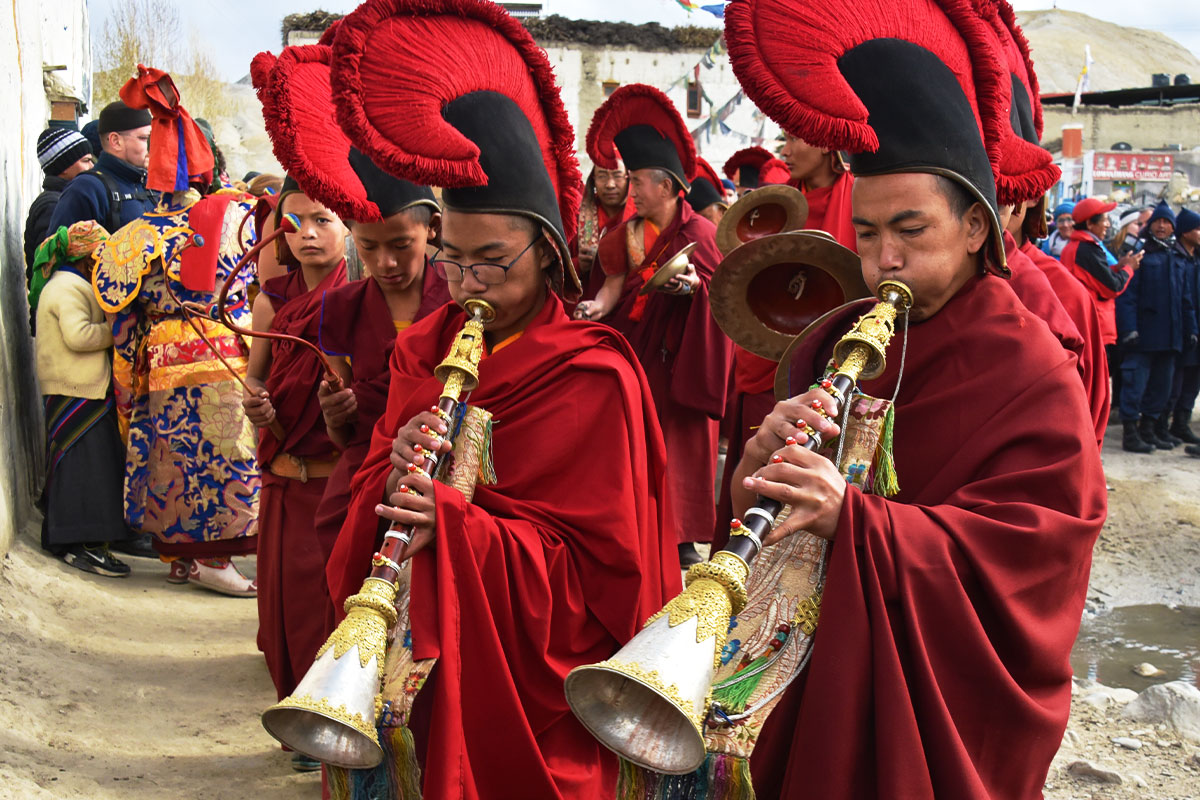
The dances themselves are performed by monks of the Sakya sect of Tibetan Buddhism, drawn from Lo Manthang, Nhenyul, and Chhosyer villages. The spiritual center for the event is the Choedhe Monastery, home to some 65 monks, which keeps alive the tradition of Cham mask dancing, Tibetan monastic chanting and butter sculpture art. The performance requires sustained concentration at high altitude and the monks train and prepare for months in advance.
The three days represent a phase of the legend, a cleansing dance, a dance of transformation and preparation for battle, and finally a dance of victory when the demon is symbolically banished from Lo Manthang for good. The result is part religious ceremony, part living theater, and part community celebration, with locals gathering at the royal palace courtyard alongside pilgrims and travelers.
For visitors, Tiji is different from other Himalayan festivals because of its setting. This isn't a temple festival in a busy city. It happens inside a centuries-old walled city, surrounded by high desert cliffs, where the crowd is still small enough that you're witnessing something closer to its original form than a tourist production.
The 3-Day Ritual Breakdown
The Tiji Festival is actually one continuous story over three days, each day leading to the final act of banishing evil from Lo Manthang. Here’s what happens with each.
Day 1: Tsa Cham (Dance of Purification)
The Tsa Cham is the first dance of the festival. It is a spiritually cleansing and calling dance that prepares the way for what will come next. In elaborate costumes and painted masks, monks from the Choedhe Monastery moved slowly and deliberately to clean the courtyard and call on guardian gods. On this first day, things aren't as crazy as they will be later. While the monks prepare the space and the spiritual atmosphere for the battle that is about to happen, it feels like a ritual and a time to meditate.
This day also acquaints the audience with the festival’s visual language: the layered silk robes, the fierce wrathful deity masks, and the rhythmic accompaniment of long horns, cymbals, and drums played by monastery musicians. The people of Lo Manthang and surrounding villages like Nhenyul and Chhosyer come together in the courtyard of the palace, many in their traditional dress, and for the day it is a religious duty and a community gathering. Day 1 is the gentlest introduction to the festival’s rhythm for first-time visitors, before things build in intensity.
Day 2: Nga Cham (The Dance of Transformation and Battle Preparation)
The energy is definitely different on day two. Nga Cham is the transformation stage in which the monks embody the deity Dorje Jono as he prepares to confront his demon father. The dance steps get more aggressive, sharper and more percussive, reflecting the tension of an approaching battle. Past visitors often describe the event as the day when the festival becomes less of a performance and more of a real-time spiritual confrontation.
Day 2 is about restoring balance before the final act, symbolically. They are thought to bring peace and strength to the community and get the monks and people watching ready for the big event. As word has it through Lo Manthang and surrounding villages that the festival is approaching its last day, it is also the day when crowds tend to swell. The mood will be more tense than the opening ceremony, with more dancing.
Day 3: Rha Cham (The Dance of Victory and Liberation)
The final day is the emotional and spiritual climax of the festival. Rha Cham presents the last battle and final victory of Dorje Jono over the demon, culminating in a mighty closing ritual. An effigy of the demon is made from barley flour called tsampa, gathered from offerings by local households. It is paraded around the ceremony and then ritually cut apart. For long years the event is marked by musket fire, a dramatic, almost startling, exclamation point to the demon's defeat.
The effigy's remains are then carried out of Lo Manthang and thrown away beyond the town's walls, a symbolic act that cleanses the land and clears the way for peace and prosperity in the year ahead. For visitors, it is the day when the festival delivers its promise of color, ritual intensity, and a genuine sense of communal relief and celebration when the demon is expelled. It is also usually the busiest day, so get to the court early to get a prime spot to view.
Essential Info: Tiji Festival 2027 Dates
The Tiji Festival is not celebrated on a fixed date every year. Because it is based on the Tibetan Lunar Calendar, the exact dates vary from year to year, so travelers should check them well in advance of booking flights or trekking permits. The festival will be held for three consecutive days in Lo Manthang from June 1st to June 3rd in 2027.
2027 Daily Schedule
-
1st June (Tsa Cham): The “Awakening” ritual, clearing the area of evil, starts the festival.
-
June 2nd (Nga Cham): The "Battle" dance depicts the fight with the demon and its defeat
-
June 3rd (Rha Cham): The “Victory” celebration, with the final banishment ritual and the public blessings of the monks.
Lo Manthang has limited accommodation and the few hotels that provide quality service for high-end travelers fill up quickly around festival dates, so you should book your trip and hotel well in advance. It’s also worth planning to arrive in Lo Manthang at least a day before June 1st so you don’t miss the opening Tsa Cham ritual and have time to acclimate before the festival’s most demanding days.
Planning Your Journey: Trek vs. Jeep
Getting to Lo Manthang for the Tiji Festival is a case of two options: the classic multi-day trek or a faster overland jeep tour. Both trails begin in the Kali Gandaki valley and traverse the same stunning high-desert scenery, but they vary considerably in terms of pace, physical difficulty and depth of cultural immersion you can expect along the way.
|
Trip Facts |
Upper Mustang Trek |
Jeep Tour |
|---|---|---|
|
Route |
Kagbeni → Chele → Ghami → Tsarang → Lo Manthang |
Jomsom/Kagbeni → Lo Manthang via jeep track |
|
Duration |
Typically 10-14 days round trip |
4-6 days round trip |
|
Physical demand |
Moderate to high, daily walking at altitude |
Low, mostly vehicle-based |
|
Best for |
Trekkers wanting immersive village-to-village experience |
Travelers with limited time or lower fitness levels |
|
Cultural exposure |
Higher, more village stops, monasteries, and interactions |
Lower, faster pass-through of villages |
|
Scenery |
Close-up views of canyons, cave complexes, and mani walls |
Same landscape, viewed from the road |
|
Accommodation en route |
Teahouses and guesthouses |
Hotels in Jomsom, Kagbeni, or Lo Manthang |
Sample Itinerary: Trek + Jeep Combo Options
If you'd rather not choose between trekking and driving, Upper Mustang offers both, and Utmost Destination runs dedicated packages for each.
Classic Trek Route (16 Days)
|
Day |
Route |
|
1-2 |
Arrive Kathmandu, heritage sightseeing, fly to Pokhara |
|
3 |
Fly to Jomsom, drive to Muktinath, trek to Kagbeni |
|
4-8 |
Trek through Chele, Syangboche, Ghaymi, Charang to Lo Manthang |
|
9 |
Explore Lo Manthang (festival days fall here) |
|
10-13 |
Trek back via Drakmar, Ghiling, Chhuksang to Jomsom |
|
14-16 |
Fly to Pokhara, then Kathmandu, departure |
See the full Upper Mustang Trek itinerary and pricing.
Luxury 4WD Jeep Route (15 Days)
|
Day |
Route |
|
1-2 |
Arrive Kathmandu, sightseeing, fly to Pokhara |
|
3-4 |
Drive to Kagbeni via Marpha, day trip to Muktinath |
|
5-6 |
Drive to Ghami via Syangboche Pass, on to Lo Manthang |
|
7-8 |
Explore Lo Manthang (festival days fall here) |
|
9-10 |
Drive back via Chhusang to Jomsom, then Pokhara |
|
11-15 |
Pokhara sightseeing, Chitwan National Park extension, Kathmandu departure |
See the full Luxury Upper Mustang 4WD Jeep Tour itinerary and pricing.
For travelers who want a physical challenge but prefer wheels to trekking boots, Utmost also runs a 13-day Upper Mustang Bike Tour that covers the same route by mountain bike.
Note: none of these standard packages are dated to festival week specifically, so flag to your ops team that Tiji-timed departures need custom scheduling around June 1-3 (2027) to land travelers in Lo Manthang for all three days.
Permits and Regulations
Upper Mustang is a restricted region, so unlike most of Nepal's trekking areas, you can't simply show up with a visa. Two permits are mandatory, and both must be arranged through a registered trekking or tour agency; independent travel isn't permitted here.
Restricted Area Permit (RAP)
-
Cost: USD 500 per person for the first 10 days, then USD 50 per additional day
-
Check-in point: Ghami
-
Time-limited, so plan your itinerary to fit the permit window (Utmost's standard packages are built around this)
Annapurna Conservation Area Permit (ACAP)
-
Cost: NPR 3,000 for foreign nationals, NPR 1,000 for SAARC nationals
-
Check-in point: Ghasa
-
No time limit, valid until checkout at the designated checkpoint
TIMS Card
-
Required for all trekkers in Nepal, including those trekking (not driving) into Upper Mustang
-
Processed by your agency alongside the RAP and ACAP
How it works with Utmost Destination
All permits are included and handled directly by the operator on both the Upper Mustang Trek and the Luxury Upper Mustang 4WD Jeep Tour, you'll just need to provide passport details and passport-size photos in advance. Since the Restricted Area Permit is date-bound, book early for Tiji week so your agency can time the permit window to cover all three festival days without forcing an early exit.
Accommodation: Staying in Lo Manthang
Accommodation in and around Lo Manthang ranges from basic teahouses to genuinely luxurious boutique lodges, and which end of that spectrum you land on depends heavily on which package you book and how far ahead you plan. For trekkers, lodging along the classic route is simple and family-run: teahouses and guesthouses in villages like Kagbeni, Charang, and Lo Manthang itself offer twin-sharing rooms with basic wooden beds and shared facilities. Electricity and Wi-Fi are inconsistent this far into the restricted area, and hot showers often cost extra, so travelers should set expectations accordingly rather than expect hotel-standard comfort.
For those booking the jeep or luxury route, the region has quietly built up a small but impressive network of high-end stays. Shinta Mani Mustang in Jomsom and its affiliated Moksha Muktinath property offer boutique comfort close to the airstrip and the sacred temple, respectively, while Lo-Mustang Himalayan Resort near Muktinath features handcrafted Tibetan furniture and local rugs. Further along the route, Hotel Royal Mustang in Ghami and Maya Heritage Inn in Tsarang provide comfortable overnight stops, and in Lo Manthang itself, Royal Mustang Resort stands out for its architecture styled after the old royal palace of the Lo Kingdom.
Because Lo Manthang has only a handful of hotels capable of serving high-end clients well, and because everyone wants to be in town for the same three festival days, rooms during Tiji week sell out fast. This is the single biggest reason to book early; arriving even one day before the festival begins to secure decent lodging is standard advice from operators who've run Tiji trips before. Both the Upper Mustang Trek and the Luxury Upper Mustang 4WD Jeep Tour include accommodation as part of the package, with the jeep tour built around the premium properties mentioned above.
Health, Safety, and Etiquette
Altitude Sickness & Physical Preparedness
-
Lo Manthang is at about 3,800m high, with some routes reaching 4,200 m.
-
Early symptoms Headache, Dizziness, Nausea, Fatigue: Look out for
-
Don’t push through; rest and descend immediately if symptoms worsen.
-
Both trek and jeep packages along the route include acclimatization stops.
-
Keep hydrated throughout; thin air dehydrates faster than you think.
Medical Facilities & Insurance
-
Medical facilities in Upper Mustang are basic and few.
-
Bring a personal first aid kit with basic medication.
-
High-altitude trekking and helicopter rescue travel insurance is highly recommended.
-
Before you leave, confirm your agency’s emergency evacuation protocol.
Photography and Cultural Etiquette
-
Always ask before photographing monks, locals or private homes.
-
Some ritual moments during Tiji may be off-limits for photography; consult with your guide on-site.
-
Dress modestly, especially in monasteries and during the ceremony.
-
Please follow local protocol for seating in the courtyard. Do not block sightlines or walk through dance space.
-
Take off hats and speak quietly during active rituals.
General Respect for Local Customs
-
Upper Mustang is very Tibetan Buddhist. Treat monasteries, chortens and manor walls as you would any active place of worship.
-
As is customary, walk clockwise around mani walls and stupas.
-
Always ask before entering private courtyards or homes.
-
Tourism is the main source of income here, so support local guesthouses and guides
What to Pack for Early June
Clothing
-
Lightweight thermal base layers (top and bottom)
-
Fleece or light down jacket for cold mornings and evenings
-
Waterproof, windproof outer jacket and pants
-
Trekking or travel pants, breathable and quick-drying
-
Warm hat and a separate sun hat/cap
-
Insulated gloves or thermal mittens
-
Buff or neck gaiter for dust and wind protection
Footwear
-
Comfortable, broken-in trekking boots
-
Camp sandals or shoes for evenings
-
Several pairs of moisture-wicking trekking socks
Gear
-
Daypack (30-50L) for daily use
-
Sleeping bag, even on jeep tours, some lodges run cold
-
Trekking poles if walking any portion of the route
-
Reusable water bottle plus purification tablets or filter
-
Headlamp with spare batteries
-
Power bank, charging access is limited and inconsistent
Personal Items
-
Sunscreen and lip balm: UV exposure is intense at altitude
-
Sunglasses, ideally UV-protective
-
Basic first aid kit and personal medication
-
Toiletries and a quick-dry towel
-
Camera: this is a festival built for photography
-
Cash in Nepali rupees; cards aren't usable in Lo Manthang
-
Passport, permit documents, and passport-size photos
Weather Note
-
Early June sits at the tail end of spring in Upper Mustang; expect strong daytime winds, cold nights even as days warm up, and occasional early-monsoon showers lower down the route toward Jomsom and Pokhara
Why You Should Go in 2027
Tiji isn't a festival that's been packaged for tourism. It's a living ritual that the people of Lo Manthang have performed for roughly 600 years, and travelers are welcomed as witnesses rather than an audience. That distinction matters. Unlike more accessible cultural festivals in Kathmandu or Pokhara, reaching Lo Manthang requires real effort: a restricted area permit, several days of travel, and enough physical readiness to handle the altitude. That barrier to entry is precisely what has kept the experience intact, and it's disappearing. As Upper Mustang opens further to tourism and infrastructure slowly improves, the raw, unfiltered version of Tiji available today won't look the same in a decade.
A few reasons 2027 is worth the trip:
-
Witness a 600-year-old ritual performed by monks in one of the last regions of Nepal that remained closed to outsiders until 1992
-
Experience Lo Manthang's walled medieval city, still largely unchanged, alongside the festival itself
-
See the full three-act narrative arc, cleansing, battle, and victory, play out in real time, not as a staged reenactment.
-
Combine the festival with some of the Himalaya's most dramatic high-desert scenery, including the Kali Gandaki Gorge and views of Annapurna, Dhaulagiri, and Nilgiri.
-
Travel through a region where tourism numbers remain genuinely low compared to Everest or Annapurna, so the experience feels earned rather than commercialized
-
Support a local economy where tourism directly funds monastery preservation and community livelihoods
Best Tips for Tiji Success
-
Book 4-6 months ahead—hotel rooms in Lo Manthang are limited and sell out fast for festival week.
-
Arrive at least one day early—this strategy guarantees you catch the opening Tsa Cham ritual and gives your body a buffer to acclimatize.
-
Choose your route based on fitness, not romance—the trek is rewarding but demanding; the jeep tour delivers the same festival experience with far less physical strain.
-
Confirm your Restricted Area Permit dates cover all three festival days—since the permit is time-bound, a poorly timed booking can force an early exit before Rha Cham.
-
Pack cash in Nepali rupees—there are no ATMs or card payments in Lo Manthang.
-
Bring a wide-angle and zoom lens if you're serious about photography—courtyard seating means you'll want flexibility to capture both crowd scenes and close-up ritual detail.
-
Ask before photographing monks or locals directly—and follow your guide's lead on which ritual moments are off-limits for cameras.
-
Stay hydrated and watch for altitude symptoms from day one—Lo Manthang sits close to 3,800m, and festival excitement can make people ignore early warning signs.
-
Get to the courtyard early each day—prime viewing spots fill up fast, especially on the final day.
-
Travel with a registered agency—independent travel isn't permitted in this restricted region, and a good guide adds context to rituals that would otherwise be difficult to interpret as an outsider
Conclusion: Ready for the Forbidden Kingdom?
The Tiji Festival isn't just a photo opportunity in an exotic setting; it's a rare chance to witness a living Buddhist tradition performed exactly as it has been for six centuries, in a place that spent most of its history closed to the outside world. From the opening cleansing dance to the final banishment of the demon effigy, every moment of those three days in Lo Manthang carries genuine spiritual weight for the people performing it.
Getting there takes planning: permits booked early, accommodation secured months in advance, and a route chosen that matches your fitness and travel style, whether that's the immersive Upper Mustang Trek, the adventurous Upper Mustang Bike Tour, or the comfort of the Luxury Upper Mustang 4WD Jeep Tour. But for travelers willing to make that effort, the reward is a Himalayan experience that few others get to have.
Save the date June 1-3, 2027. Start planning today. The Last Forbidden Kingdom awaits.