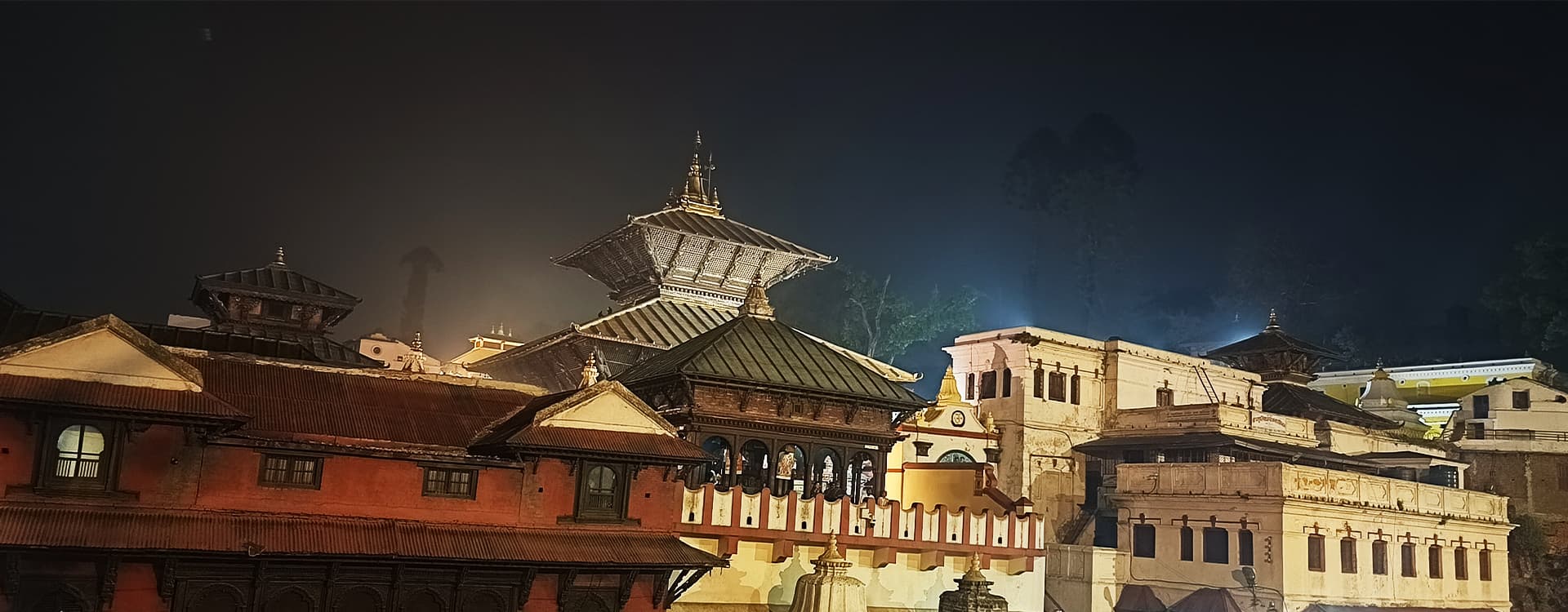
In Nepal, twelve Shivaratris are celebrated annually, on the 14th night of every lunar month. But only one of them is called Maha Shivaratri—the Great Nite of Shiva. It is celebrated in the month of Falgun (February or March) to commemorate the divine union of Lord Shiva and Parvati. The festival is set for February 15, 2026.
For Hindus, this night is one of the most important occasions mentioned in the Puranas. Devotees observe a night-long fast and offer bel-patra and worship the Shiva lingam with devotion. Pashupatinath Temple in Kathmandu, a UNESCO World Heritage site and one of the holiest Shiva temples in the world, is at the heart of it all, where thousands gather to chant, pray and keep vigils until dawn.
There are few chances for the traveler to see a centuries-old ritual, ash-smeared sadhus, and a city transformed by faith, all in one night, but Maha Shivaratri is one of them.
Who is Lord Shiva?
Lord Shiva is one of the Trimurti/Trinity of the Universe, along with Lord Brahma and Lord Vishnu, in Hindu Mythology. Lord Shiva, also known as Mahadev, Shankar, Neelkantha, Bholenath, etc., is called Devo ka Dev—God of all Gods with the Supreme Power of the Universe. Lord Shiva is considered the destroyer as well as the regenerator and creator of both death and life. In the Shiva Puranas, Lord Shiva is considered the Great Yogi or Adi Yogi, regarded both as the fierce God and the most magnanimous, as he’s worshipped by both the Asuras and the Devtas. Similarly, Lord Shiva has 19 avatars, some of them Veeabhadra, Bhairava, Durvasa, and Piplaad.
In modern science, everything that comes from nothing goes back to that nothing. Based on this cosmological philosophy, the nothingness of the grand galaxies seems to be sprinkling like a star, and the rest is all vast space—and that’s Shiva, as said. The vastness of the space is referred to as the womb and the oblivion from where everything is born and taken back within, hence depicting Shiva generating and destroying every matter in the universe over time.
Why is Maha Shivaratri Celebrated?
There isn't just one story behind Maha Shivaratri. Hindu mythology gives us a few, and together they explain why this night means so much to devotees.
The most popular one is the wedding of Shiva and Parvati. According to legend, the festival is the night Lord Shiva married Goddess Parvati, uniting divine masculine and feminine energy. Devotees see it as a celebration of that union, and many unmarried women observe fasts on this day hoping for a suitable life partner, just as Parvati's devotion won her Shiva.
Again, one story is about the Samudra Manthan, the churning of the cosmic ocean. During the churning of the ocean by the gods and demons in search of the nectar of immortality, the deadly poison Halahala was produced. The poison was powerful enough to destroy the universe itself. Lord Shiva drank the poison to save all beings and held it in his throat, not in his stomach. And so he came to be called Neelkantha, the blue-throated one. The devotees keep vigil through the night to thank the sacrifice.
There is also a belief that this festival is the time when Lord Shiva performed the Tandava Nritya, his cosmic dance. This dance symbolizes the never-ending cycle of creation, preservation and destruction that moves the universe.
Apart from the stories, Maha Shivaratri is also about an uncomplicated spiritual message. It is often called a triumph of light over darkness. The festival occurs on the darkest night of the lunar month, and the devotees see the occasion as an opportunity to overcome ignorance and awaken to something higher. The inner journey involves fasting, staying awake and meditating through the night.
So while the rituals are similar year after year, the reasons behind them are deep, touching on love, sacrifice and spiritual awakening, all at once.
Maha Shivaratri 2026 Date
Maha Shivaratri is observed on the Hindu lunar calendar, so the date varies each year according to the moon cycle. It always falls on the 14th day of the waning moon or Krishna Paksha Chaturdashi, in the month of Phalgun.
Maha Shivaratri will be Sunday, February 15, 2026.
This night is unique among Hindu festivals because it is celebrated in darkness, not daylight. Most festivals occur at an auspicious time of the day, but Shivaratri is on the night of the month, the darkest night of the month, the darkest nite of the month. In Shaivite belief, the darkness is not considered a negative thing. Here, darkness stands for the space before creation, the point from which darkness stands for the space before creation, and the point from where a devotee wakes up spiritually. Hence, the rituals continue from sunset until the next morning's sunrise.
If you're planning a trip around this date, it's worth building in some flexibility, since the exact timing of rituals at Pashupatinath can vary slightly depending on the lunar calendar confirmation each year.
Pashupatinath Temple: Heart of the Celebration
If there is a true home of Maha Shivaratri, it is Pashupatinath Temple in Kathmandu. This is the festival's peak, where most devotees and travelers spend the night.
Pashupatinath is a UNESCO World Heritage Site spreading over an area of about 246 hectares on the banks of the Bagmati River. The complex itself is huge with more than 500 temples and shrines but the main pagoda dedicated to Lord Shiva is still the main focus of worship. Only Hindus can enter the main sanctum, but the temple grounds are open to all and there’s plenty to see even from the outside.
During Maha Shivaratri, the temple opens all four gates to manage the sheer number of visitors. On a normal day, such an arrangement wouldn't be necessary, but on this one night, close to 50,000 people arrive to pay their respects. Opening all sides lets devotees approach and worship from every direction rather than funneling through a single entrance.
Scattered throughout the complex are also several smaller Shiva lingams, each drawing its own small crowd of worshippers. Many devotees make a point of visiting a few of these smaller shrines in addition to the main temple, treating it almost like a mini pilgrimage within the larger one.
The temple too gets a makeover in the days leading up to the festival. The walls have been newly painted, flowers are placed in the courtyards and lanterns line the paths. The whole complex looks as though it has been prepared for something big, and it has, when the festival gets underway.
For a traveler, even just walking through the temple grounds on this night gives you a real sense of how central this place is to Nepali spiritual life.
Rituals and Traditions
The rituals of Maha Shivaratri are what provide the night its rhythm. They've stayed largely the same for generations, even as the festival has grown bigger and more crowded every year.
Most of the devotees begin the day by observing a fast. Many observe a fast of a whole day and night, without food, and sometimes without water, in token of devotion and self-denial. Some prefer lighter fast, having fruits or milk, as against going without anything at all.
Priests at the temple perform the Rudra Abhishek puja, a ritual bathing of the Shiva lingam with milk, water, honey and other sacred offerings. It is believed to be one of the most powerful forms of worship for Lord Shiva and goes on in cycles throughout the night.
As for the night, the vigil is usually divided into four parts, each of approximately three hours. Each phase has its own prayers and offerings to the lingam, so the rituals essentially repeat and escalate as the night progresses. Devotees stay awake throughout all four phases, as staying awake at night is considered to be a sign of spiritual wakefulness.
During these hours you will hear chanting all the time. Om Namah Shivaya and the Maha Mrityunjaya Mantra reverberate through the temple grounds, often blended with drums and bells. It creates an atmosphere that is difficult to describe unless you have actually stood in the middle of it.
Bonfires are lit at various points around the complex, partly for warmth on a cold February night and partly as part of the symbolism around light overcoming darkness. Devotees also take ritual baths in the Bagmati River, believing it purifies both body and mind before entering the temple grounds.
At the end of the night, everyone present is given prasad (holy food) regardless of background. It is one of the more welcoming parts of the festival and it is common to see volunteers giving food and water to exhausted but joyful devotees as the sun comes up.
Sadhus and Naga Babas at Pashupatinath
One of the most eye-catching spectacles at Pashupatinath during Maha Shivaratri is the gathering of sadhus, holy men who have renounced worldly life to embark on a path of devotion to Lord Shiva. Hundreds of them travel from all over Nepal and India to participate in this festival every year and many even set up tents in the temple grounds days before the festival begins.
You’ll see them easily. Most are shrouded from head to toe in ash, a tradition connected to Shiva’s own association with cremation grounds and the belief that everything ultimately becomes dust. Some sport tikka marks, dreadlocks and plain orange robes, while others, the Naga Babas in particular, wear no clothes at all as a sign of complete renunciation of worldly existence.
Many sadhus are happy to chat, strike a pose or share stories about their spiritual journey, so don't be shy about approaching them respectfully. If you take a picture, consider making a small donation as a gesture of appreciation for their time.
One thing that often surprises first-time visitors is that marijuana use is legally tolerated around the temple on this one day each year. It's closely tied to Shiva's own mythology, where cannabis is associated with his ascetic, meditative side. You'll see sadhus smoking openly as part of their ritual practice, though it's meant as a spiritual act rather than casual recreation, and visitors are encouraged to simply observe rather than take part.
For travelers, time spent among the sadhus is often one of the most memorable parts of the whole festival, a glimpse into a way of life rarely seen at close quarters.
Maha Shivaratri and Nepal Army Day
Here's something most travelers don't expect. Maha Shivaratri isn't only a religious festival in Nepal; it also coincides with Nepal Army Day. The two have been observed together since 1991, and the pairing isn't random. In Vedic tradition, Lord Shiva is considered the protector of cosmic order and peace, which lines up closely with the role of a national army. Because of this connection, the day carries both spiritual and national significance.
The main celebrations for Army Day take place at the Army Pavilion in Tundikhel, right in central Kathmandu. It is a real ceremony with rifle salutes, artillery fire, coordinated parades and helicopter flyovers to mark the occasion. International military bands, often from India, the UK, and the US, also participate, adding an extra layer of spectacle to the day.
The President, the Supreme Commander, the prime minister, and the Chief Justice also usually attend, as do top government officials.
For visitors, this means Maha Shivaratri in Kathmandu is not only about temple rituals. If you are at Tundikhel during the day, you will see a different side of the celebration, one that is less about spiritual devotion and more about national pride. Many travelers watch the parade in the afternoon and then go to Pashupatinath for the festival's religious side.
How to Experience Maha Shivaratri as a Traveler
Maha Shivaratri can feel overwhelming for first-time visitors, simply because of the crowds and the sheer intensity of what's happening around you. A little preparation goes a long way in making the night enjoyable rather than exhausting. Here's what to keep in mind if you're planning to experience it firsthand.
-
Arrive at Pashupatinath in the early evening, before the crowds peak.
-
Wear modest, comfortable clothing that covers shoulders and knees.
-
Remember only Hindus can enter the main temple sanctum, though the surrounding grounds are open to all.
-
Carry cash for donations, water, and small offerings
-
Keep valuables secure, as the crowd gets dense as the night goes on.
-
Wear comfortable shoes, since you'll likely be standing or walking for hours.
-
Ask before photographing sadhus, and offer a small donation if they agree.
-
Stay hydrated and pace yourself if you plan to stay through the night
-
Be patient near the temple gates, since movement can be slow during peak hours.
-
Consider hiring a local guide if you want context on the rituals as they happen
More Shiva Temples in Nepal to Discover
The main attraction is the Pashupatinath but it is not the only place to pay homage to Lord Shiva in Nepal. If you have spare time around Maha Shivaratri, here are a few other temples worth adding to your list.
Doleshwor Mahadev, located in Bhaktapur, is believed by many devotees to be the head of Lord Shiva, forming a spiritual pair with Kedarnath in India, which is said to represent his body. It draws a smaller but equally devoted crowd during Shivaratri.
Kirateshwar Mahadev, tucked near Pashupatinath itself, is one of the oldest Shiva temples in the valley and often gets overlooked simply because of how close it sits to its more famous neighbor.
If this festival sparks a deeper interest in Nepal's spiritual side, it's worth exploring beyond just Shivaratri. Nepal is home to countless sacred sites tied to Hindu mythology, and a well-planned Hindu Pilgrimage Tour can take you through several of these temples in one trip, giving you a fuller picture of the country's religious heritage rather than just a single night at Pashupatinath.
Travel Tips During Shivaratri Visit
-
Book your stay in Kathmandu early, as hotels fill up quickly during this festival.
-
Heavy traffic and road closure expected near Pashupatinath. Give yourself time to travel
-
There is limited parking near the temple so use ride-sharing apps or walk when possible.
-
Pack warm layers. It can get chilly in Kathmandu at night in February
-
Bring a power bank. Cell service and battery life In large crowds, cell service and battery life may be unreliable. or miss in big crowds.
-
Keep a paper map or a digital file handy in case the network becomes congested.
-
If combining the visit with other pilgrimage sites, plan your route a day or two around the festival to avoid rushing.
-
Check with your hotel or guide about the best times to enter and exit the temple area
Conclusion
Maha Shivaratri is not just another festival in the calendar of Nepal. It’s a night of mythology, devotion and centuries-old ritual all in one place and there really is no better place to witness it than Pashupatinath Temple in Kathmandu. It could be the spiritual charge of the occasion, the gathering of sadhus from all over the region, or the energy of thousands of devotees keeping vigil through the night; it is an experience that stays with you long after the festival.
If you find yourself in Nepal around February 15, 2026, Maha Shivratri is one night to plan your trip around. If you’re hungry to see more of Nepal’s sacred sites after this experience, consider extending your journey with our Hindu Pilgrimage Tour—the perfect way to go beyond just one festival.
Want to see Maha Shivratri for yourself? Contact our team to plan your trip to Nepal this festival season.