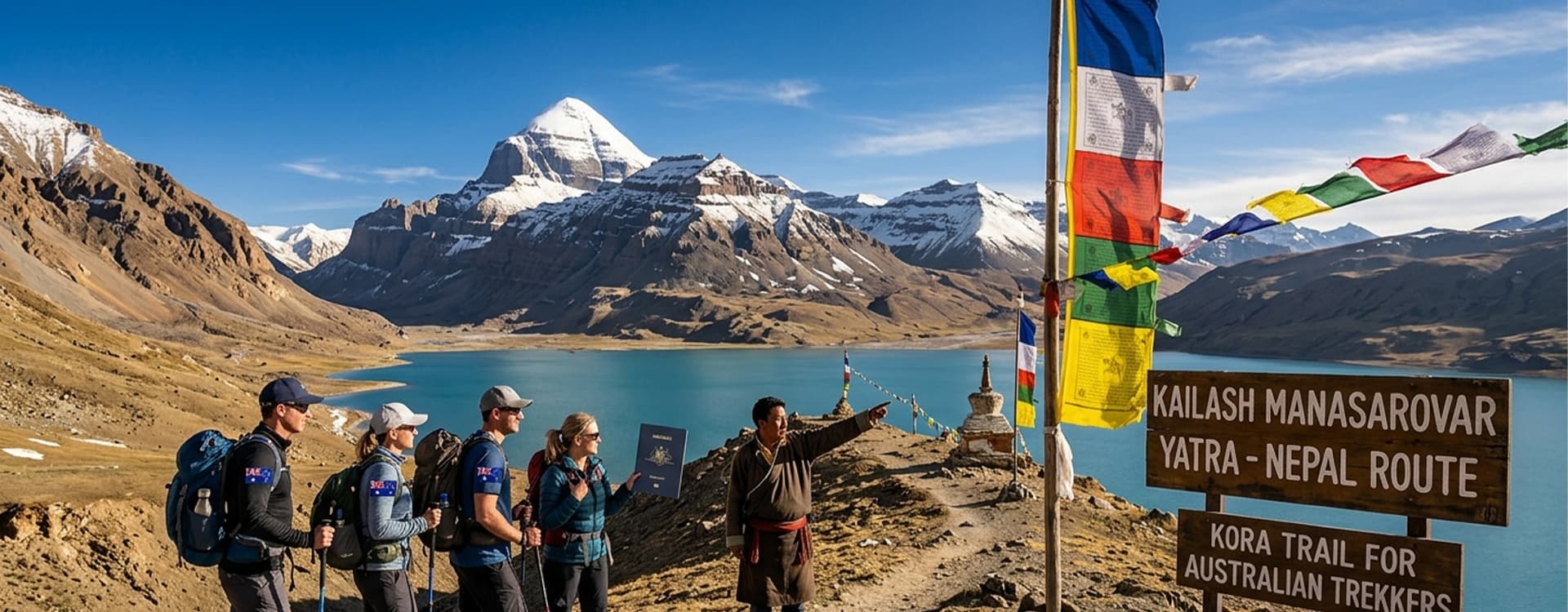
Kailash Manasarovar Yatra is one of the sacred and most spiritual tours to the Adobe of Lord Shiva. Mount kailash and Lake Manasarovar is one of the sacred sites on this spiritual tour.
Nestled at an altitude of above 5000m, in the remote land of Nagari Province of the Autonomous region of China, Mount Kailash is a high-altitude pilgrimage site. Being high altitude Pilgrimage sites, it requires serious preparation. For Hindus, it is the holy abode of Lord Shiva. For the followers of Buddhism, Jainism and Bon, it has a similar profound meaning. Every year, more Australian pilgrims and adventure travelers set out on this Mount Kailash tour, drawn by its spiritual weight and its raw, untouched landscape. It is a demanding journey, no doubt. But for those who complete it, the experience of walking around the sacred mountain and bathing in Lake Mansarovar often becomes a once-in-a-lifetime memory.
This guide breaks down everything you need to know before you go. We will cover routes from Australia, the Kailash Yatra cost, visa and permit regulations, and the best season to visit Kailash. If you’re attracted to faith or the thrill of traveling at high altitude, this manual will help you plan with confidence. Ready to start your journey to Mount Kailash? Get in touch with our travel experts today and let us help you plan a safe, well-organized Kailash Yatra from Australia.
Why Are Australians Drawn to the Kailash Mansarovar Yatra?
The number of Hindus, Buddhists, Jains, and Bon followers in Australia is growing, and for many of them, Mount Kailash has deep spiritual significance. But this pilgrimage is not just for the faithful. It also attracts adventure seekers who want to see one of the most remote and unspoiled places on earth. Here’s why so many Australians take the Kailash Mansarovar Yatra.
-
Hindus regard Mount Kailash as the sacred home of Lord Shiva, making it a deeply meaningful Mount Kailash tour for spiritual travelers.
-
Buddhists see the mountain as the seat of Demchok Buddha, and many undertake the Kailash Kora as an act of devotion
-
Jains believe it is the site where their first Tirthankara reached enlightenment, adding another layer of sacred history.
-
Followers of Bon consider the mountain the spiritual center of the universe, drawing pilgrims from that tradition as well.
-
Beyond religion, the region attracts travellers who want a genuine high-altitude pilgrimage and a break from typical tourist routes.
-
Bathing in the holy waters of Lake Mansarovar is considered a once-in-a-lifetime experience, pulling in Australians who simply want something extraordinary
Best Route Options from Australia to Mount Kailash
Overland through Nepal
The most popular way for Australian pilgrims is the overland route through Nepal to Kailash. The journey starts with a flight into Kathmandu, followed by a few days there to rest, sort out permits, and begin acclimatizing to the altitude. From Kathmandu, the group travels by road through the Kyirong border crossing into Tibet, then continues to Lake Mansarovar and Mount Kailash. This route tends to be more budget-friendly than flying into Lhasa, and it gives travelers a gradual climb in altitude, which helps the body adjust. It does mean longer days on the road, so it suits travellers who are comfortable with a slower, more grounded pace.
Via Lhasa
The Mount Kailash Lhasa route takes a different path. Rather than arriving through Nepal, travellers fly straight into Lhasa, the Tibetan capital, and spend a few days there before setting off by road to Kailash. This is generally more expensive, but you get better hotels, easier logistics and the chance to see Lhasa's famous sights, including the Potala Palace, en route. It suits travellers who prefer comfort over a bare-bones pilgrimage experience or those who simply want to explore more of Tibet while they are there.
Helicopter Route
For those short on time or unable to handle long overland travel, the helicopter route to Kailash yatra offers a faster way in. Pilgrims fly from Kathmandu to Simikot, then take a helicopter to Hilsa, right on the Nepal-Tibet border, before continuing overland to Kailash. This route compresses what is normally a two-week journey into just nine to eleven days. It is the most expensive option, and it comes with less time to acclimatize, so it works best for seniors, working professionals with limited leave, or anyone who wants to prioritize comfort and speed over a slower, more traditional journey.
Route Comparison at a Glance
|
Route |
Duration |
Comfort Level |
Approx. Cost (AUD) |
Best Suited For |
|
15 days |
Basic to moderate |
4,000 to 5,000 |
Budget conscious travellers, first timers |
|
|
18 days |
Moderate to high |
6,000 to 7,000 |
Travellers wanting comfort and culture |
|
|
12 days |
High, but demanding |
5,500 to 9,000 |
Seniors, limited leave, time-constrained travellers |
Getting There — Flights from Australia
The journey to Mount Kailash begins with a long-haul flight to Kathmandu, as Nepal is the main gateway to most Australian pilgrims. There are no direct flights from Australia to Kathmandu, and travellers usually fly from Sydney, Melbourne or Brisbane and connect through a major hub. Singapore Airlines has a seamless connection through Singapore, Qatar Airways via Doha and Malaysia Airlines via Kuala Lumpur. Cathay Pacific via Hong Kong and Thai Airways via Bangkok are other options. Total travel time usually falls between 14 and 18 hours, depending on the layover and airline chosen.
Once you land in Kathmandu, it is worth spending a day or two there before heading further into the mountains. This time is not just for rest. It gives your body a head start on acclimatising to higher altitude, and it also gives your tour operator time to finalise permits and the Chinese group visa before the group crosses into Tibet. Many travellers use these days to explore Kathmandu's temples and markets as well, which adds a nice cultural start to the Kailash Mansarovar Yatra from Australia before the more demanding part of the journey begins.
Kailash Mansarovar Yatra Cost from Australia (2027)
Standard Overland Packages
Most Australian pilgrims choose the standard overland package, which is a good mix of cost and experience. These packages typically cost between AUD 4,000 and AUD 5,000 per person and include permits, transport, meals and basic accommodation along the route. Accommodation will normally be a mixture of three-star hotels in Kathmandu and simple Tibetan guesthouses nearer to Kailash. This provides comfort without unnecessary cost. This level is for those who want to experience the authentic pilgrimage but without paying for unnecessary luxury that they may not need.
Luxury and Upgraded Packages
Travellers who prefer more comfort along the way often choose a luxury Kailash tour, which usually falls between AUD 6,200 and AUD 7,800 per person. These packages include four-star hotels in Kathmandu, upgraded accommodation in Tibet, and smoother logistics overall. It is a good fit for older travellers, those with less time to spare, or anyone who simply wants a more relaxed pace during a physically demanding trip.
Helicopter Tour Cost
The helicopter route sits at the higher end, generally between AUD 5,500 and AUD 9,000 per person. Since it cuts the journey down to nine or eleven days, the higher price reflects both the time saved and the convenience of skipping most of the overland travel. This option works well for pilgrims who cannot commit to a longer trip but still want to complete the full yatra.
Visa and Permit Requirements for Australian Travellers
While planning your Kailash Mansarovar Yatra from Australia, the biggest thing to keep in mind is to get the paperwork right. China has added more than 60 countries to its visa-free list since 2025, including Australia. With more travel options, Australians can now travel to mainland China for up to 30 days without a visa. But it is important to understand that this exemption does not apply to Tibet. The Kailash and Mansarovar region falls under special travel restrictions, so pilgrims still need a separate set of permits before they can enter.
No one can visit Mount Kailash on their own. Every traveller must join a licensed group tour, and your tour operator handles the permit and visa process on your behalf. Here is what Australian pilgrims need before setting off:
-
Tibet Travel Permit (TTP), which acts as an official invitation from Tibetan authorities and is required for anyone entering the region
-
Chinese Group Visa, arranged through the Chinese Embassy in Kathmandu once your tour operator has secured the TTP
-
Aliens' Travel Permit, also known as the Military or PSB Permit, needed since Kailash and Mansarovar sit in a sensitive border area
-
A valid Australian passport with at least nine months of validity beyond your return date, along with enough blank pages for entry stamps
-
Confirmation that you are travelling as part of a pre-approved group, since independent or solo travel into the region is not allowed
Because permit processing can take several weeks, it is best to start the application process 60 to 90 days before your planned departure. This allows your tour operator enough time to handle delays and confirm everything before you fly out.
Best Time to Visit Mount Kailash from Australia
The best time to visit Kailash falls between May and September, when the weather across the Tibetan plateau is at its most stable. During these months, the high mountain passes stay open, temperatures are more bearable, and the risk of sudden snowfall drops significantly compared to the rest of the year. For Australian travellers making the long trip out, this window offers the safest and most comfortable conditions for both the overland journey and the Kailash Kora, the sacred trek around the mountain itself. Outside this period, harsh winter conditions set in, roads become difficult to travel, and most tour operators pause their trips altogether. Planning your Kailash Mansarovar Yatra from Australia around this season gives you the best chance of a smooth, uninterrupted pilgrimage.
For many travellers, one date within this window stands out, and that is Saga Dawa, a festival held on the full moon of the fourth lunar month, typically in May or June. It celebrates the birth, enlightenment and death of Buddha, and attracts pilgrims from all over the world who want to see the celebrations at their most meaningful. For many, however, the significance of bathing in Lake Mansarovar at this time is even greater, as it is believed to cleanse the soul of sins from lifetimes. If your travel dates coincide with Saga Dawa, plan your yatra accordingly and make it an even more memorable journey. That said, the season also brings larger crowds, so if you’re after something a bit more peaceful, consider late July through September instead
Health, Fitness, and Altitude Preparation
The Kailash Mansarovar Yatra is as much a physical challenge as it is a spiritual one. Much of the route sits above 4,500 meters, and the air at that height carries far less oxygen than what your body is used to at sea level. This is not meant to scare you off. Thousands of travelers, including many older pilgrims, complete the yatra safely every year. But it does mean preparing your body ahead of time and knowing what to expect once you are up there. A little planning goes a long way toward making the high-altitude pilgrimage safer and more enjoyable.
-
Altitude sickness is common at these heights, so mild symptoms like headaches or breathlessness are normal and usually pass with slow acclimatisation.
-
Building up general fitness a few months before departure, through regular walking, hiking, or cardio, makes the physical demands much easier to handle.
-
A medical checkup before you leave is worth doing, especially for older travelers or anyone with an existing heart or lung condition.
-
Age alone does not rule anyone out, but a doctor's clearance gives peace of mind before committing to a trip this demanding.
-
Travel insurance that covers high-altitude evacuation is essential, since medical help in this remote region is limited.
-
Staying hydrated, eating well, and pacing yourself during the trek all help your body adjust more smoothly to the thinning air.
How to select a tour operator for Kailash Yatra?
The success of the Kailash Mansarovar Yatra from Australia depends on choosing the right operator. Permits, visas and safety all depend on the company you travel with, so it is worth taking time to choose carefully rather than booking the first package you find. Here’s what to check before you purchase:
-
Ensure that the operator holds licenses for Tibet Travel Permits and Chinese Group Visas, since an unlicensed agency may cause delays or even cancellation of your trip.
-
Find a company with real experience on this particular route, not just basic Nepal or Tibet tours, as Kailash requires specialized permit handling.
-
Ask about group size—smaller groups mean better support, more flexibility, and a smoother high-altitude experience.
-
Look at their safety record, including how they handle altitude sickness, medical emergencies, and evacuation if something goes wrong.
-
Make sure that the package has transparent inclusions so that you know exactly what is covered and what extra costs might come up along the way.
-
Read reviews or ask for references of previous pilgrims, as firsthand experience often speaks louder than a polished sales pitch.
At Utmost Destination, we bring years of experience guiding pilgrims through Nepal and Tibet, with full support on permits, visas, and every logistical detail along the way. Our small group sizes and on-the-ground expertise mean you get personal attention throughout the journey, not just a seat on a bus. If you are planning your Kailash Mansarovar Yatra, we would be glad to help you put together a trip that is safe, well-organized, and true to the spiritual weight of the journey.
Is the Kailash Mansarovar Yatra Right for You?
The Kailash Mansarovar Yatra from Australia is not an uncomplicated journey, but one that stays with you long after you have returned home. It may be faith, the challenge of high-altitude travel, or the lure of one of the most remote and sacred places on earth that draws you here, but this trip offers something that few other trips can match. With the right preparation, the right permits, and a trusted operator by your side, it can be a safe and deeply rewarding experience rather than one that is overwhelming.
Utmost Destination has been helping pilgrims and travelers to plan their journey to Mount Kailash with care, from sorting out permits and visas to guiding you through every step of the route. If you’re ready to start planning your own Kailash Mansarovar Yatra, contact our team today. We will guide you through the right season, the right route, and a package that will suit your needs so you can concentrate on the journey itself.